Since 23 April 2026

Reviewed
Daiwa Connoisseur Pro Match Rod
Lowest in-stock price
£194.99
from Total Fishing Tackle
Compared across 7 shops, with 6 currently in stock
5 Things To Know
- Seven lengths run from 11ft 6in up to 15ft, including 14P and 15P Power variants for heavier loading.
- The X45 carbon and HVF Nanoplus blank is reinforced diagonally to resist twist, and runs around 10% lighter than the previous Connoisseur.
- SeaGuide stainless HLG ceramic rings resist saltwater corrosion and run mainline cleanly.
- A lightweight Air Sensor graphite reel seat and Duo Duplon Armlock handle keep the overall weight down on long rods.
- It is featured in our best float fishing rods guide.
Product Information
| Lengths | 11ft, 13ft |
Daiwa Connoisseur Pro Match Rod Review
The Daiwa Connoisseur Pro Match is one of the more interesting float-rod refreshes of recent years. The outgoing Connoiseur Float earned its place on UK match banks for a long time, and Daiwa have properly moved the range forward here rather than slap a new paint job on an old blank.
What stands out is the tech package. The X45 Carbon with HVF Nanoplus blank, V-Joint Alpha spigots and Daiwa's Air Sensor reel seat are all flagship-grade components that you normally only see on the Airity X at twice the price.
On the Pro Match they come as standard across all seven variants. The range covers every point on the float-fishing spectrum. The 11ft 6in 2-piece for quick-strike commercial waggler work, the 13ft as the everyday all-rounder, the 14ft and 15ft with standard and Power options for more demanding river sessions, and the 17ft 4-piece as a dedicated long-trotting specialist.
For match and pleasure anglers who want a rod that feels properly high-end without the flagship price tag, the Pro Match is a genuinely strong pick. It earns its place in our Best Float Fishing Rods guide as one of the best mid-premium float rods on the market.
Build quality 9.0/10
Casting & Feel Rating 8.5/10
Playing Fish Rating 8.5/10
Value for money 8.0/10
How well is it built?
Daiwa's Connoisseur name has been attached to serious float rods for decades, and the Pro Match is the latest refresh of that long-running range.
Where the outgoing Connoiseur Float leaned on solid-but-familiar carbon construction, the Pro Match brings flagship blank technology down a tier from the Airity X.
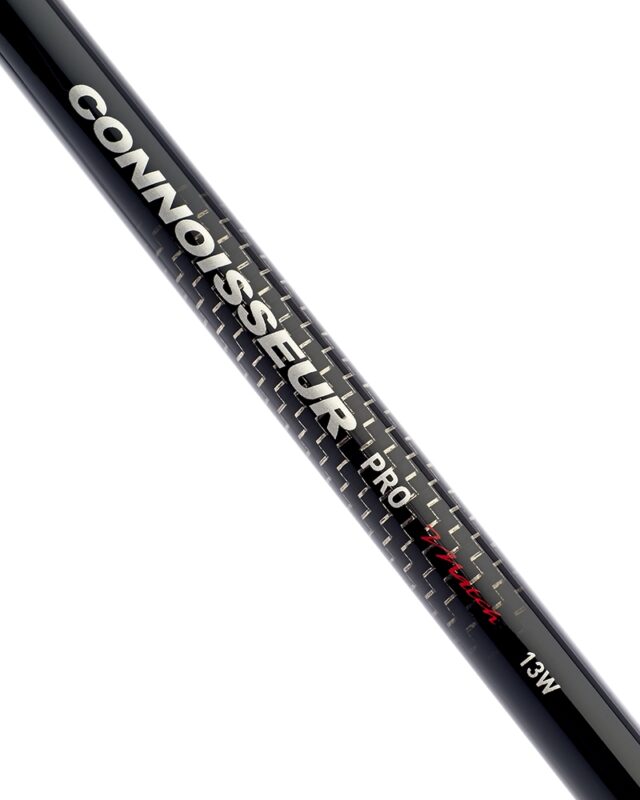
The blank is built on Daiwa's X45 Carbon with HVF Nanoplus, a combination you normally only see on top-shelf Daiwa rods.
X45 is a torque-resistant carbon wrap applied in the key loading zones of the blank, which means the rod stays straight under the cast rather than twisting sideways.
HVF Nanoplus is the resin system that fills the micro-gaps between fibres for a stiffer-for-its-weight blank. Hardware is straight flagship across the range.
SeaGuide Stainless Steel HLG ceramic-lined guides run the length, paired with Daiwa's own Air Sensor reel seat. The Air Sensor is lightweight graphite with a positive down-locking ring, and the slim profile keeps your fingers closer to the blank for better bite feel.
The Duo Duplon Armlock handle is the same shape Daiwa use on their premium match rods, cutaway under the forearm so the butt section tucks in naturally on long casting sessions. A folding hook keeper and V-Joint Alpha Ergonomic spigots round out the build.
The V-Joint is the flagship joint design that keeps the blank curve continuous under load rather than developing a flat spot where the sections meet.
9.0 on build is the right call for a rod that brings Daiwa's flagship technology package to a sub-flagship price tier.
How well does it cast and feel?
The 13ft Pro Match sits notably lighter than the outgoing Connoiseur. Daiwa claim some models are around 10 per cent lighter than the previous generation, and on the 14ft and 15ft variants that saving shows up as less wrist fatigue over a long session.
The SeaGuide HLG guides do proper work on the cast. Line flow is smooth and friction-free, and the stainless frames keep everything aligned even when the rod gets a soaking in the rain.
A 10g waggler casts to 30 yards cleanly, and stepping up to the Power variants the rod loads comfortably with heavier bomb or slider rigs into the 15g plus window. Balance is the standout.
The Air Sensor reel seat has a slim profile, and with a 2000 or 3000 size match reel fitted, the centre of gravity drops back towards the grip rather than out towards the tip.

That keeps the rod lively on repeat casting and stops it becoming tip-heavy after an hour of waggler work.
The 11ft 6in 2-piece version is the one to look at for anglers used to longer rods. At 130g and the shorter length, the tip speed on the strike is noticeably quicker for tight pellet waggler work on commercials.
8.5 on casting reflects a rod that gets the important things right, and sits close enough to the Airity X tip speed that most anglers will not feel the gap.
How does it perform when playing fish?
The Pro Match sits in the part of the Daiwa float rod range where you want real fish-playing range, not just a match rod with pretty fittings.
Across seven lengths from 11ft 6in up to 17ft, the rod range is asked to land everything from small F1s on 0.12mm hooklengths through to hard-running chub or barbel on rivers.
The V-Joint Alpha spigot is the key piece of engineering. On a 3-piece or 4-piece rod, the traditional weak point is the section joins, where the blank can develop flat spots that transmit shock through the fight.
The V-Joint tapers the spigot so the transition is smooth, and under a running fish the blank curves as one continuous bend rather than hingeing at the joints.
On the 13ft that shows up as fewer hook pulls on F1s at the net, where sudden lunges usually cost you fish on cheaper rods.
On the 14ft and 15ft Power variants, the extra backbone in the lower section gives you the confidence to lean into barbel in flow or big tench on gravel pits. The Airity X is still the sharper fish-playing tool in the Daiwa lineup for match-specific work.
The Pro Match trades a touch of that absolute refinement for genuine versatility across more conditions, and for most anglers that trade is the right call.
8.5 on fish playing is a fair reflection of a rod that cushions light hooklengths without folding under proper weight.
Is it good value for money?
There is an obvious question anyone looking at the Pro Match has to answer, which is whether the step up from a mid-tier float rod like the Guru N-Gauge Pro Float is worth paying for. The honest answer depends on what you fish for and how often.
Typical street pricing sits around the £199 mark on the standard 13ft, with the Power variants stepping up modestly above that. The Pro Match sits comfortably above the usual mid-tier commercial float bracket, and short of the flagship territory where the Airity X lives.
For most serious match and pleasure anglers, that is the sweet spot. What you are actually paying for is the X45 Carbon with HVF Nanoplus, the V-Joint Alpha joint system, the Daiwa Air Sensor reel seat, and the SeaGuide HLG ceramic guides.
All are normally flagship-only components, and on the Pro Match they come as a package across the range. If you already own a mid-tier float rod and fish casually on commercials, the step up is a nice-to-have rather than essential.
If you fish varied venues and want one rod range that covers light waggler work, commercial carp, stick float and long trotting on rivers, the Pro Match earns its place. The seven-variant range is the hidden value point that most mid-tier ranges cannot match.
8.0 on value reflects a rod that delivers genuine flagship-grade technology at a meaningful discount to the top tier.
Pros
- X45 Carbon with HVF Nanoplus blank stays rigid under load
- V-Joint Alpha spigot removes flat spots across the joints
- SeaGuide HLG ceramic guides give smooth long casts
- Duo Duplon Armlock handle cutaway sits comfortably under the forearm
- Seven-variant range from 11ft 6in through to 17ft
Cons
- Flagship-grade price sits above most mid-tier float rods
- Seven-variant range means choosing the right length takes research
- Airity X still sits above for pure match-specific work
Features and Specifications
| Feature | What this means |
|---|---|
| Blank construction: X45 Carbon with HVF Nanoplus | Daiwa uses a high-density carbon fibre with extra reinforcement wrapped diagonally across the blank. In plain terms, the rod stays straight when you cast and does not twist sideways, so wagglers land where you aim them even at distance. |
| Joint design: V-Joint Alpha Ergonomic | The spigot joints where the sections meet are shaped to bend smoothly instead of creating a flat spot. When you hook a fish the rod curves through all three sections as one piece, giving you more control and fewer hook pulls. |
| Line guides: SeaGuide Stainless Steel HLG ceramic | Stainless-framed rings with hard ceramic inserts. Stainless will not rust when you fish in the rain or over saltwater margins, and the ceramic polish lets line flow freely so you get longer casts with less effort. |
| Reel seat: Daiwa Air Sensor | A lightweight graphite reel seat with a down-locking ring. It shaves grams off the overall rod weight and the slim profile keeps your fingers closer to the blank, so you feel tiny float-dipping bites through the handle rather than watching the tip. |
| Handle: Duo Duplon Armlock | A shaped EVA-style handle with a cutaway under-forearm section. On longer 14ft and 15ft rods your wrist does the work of holding the tip up all day, and the Armlock takes that strain by letting the butt tuck in under your elbow. |
| Folding hook keeper | A small metal hook holder on the blank that folds flush when not in use. Keeps your hook secure between swims or on the walk back to the car, but folds away so it cannot catch line during a long cast. |
| Range of models: seven lengths | The range runs 11ft 6in 2-piece, 13ft 3-piece, 14ft 3-piece (standard + Power), 15ft 3-piece (standard + Power), and 17ft 4-piece. Shorter rods suit tight commercial pegs, 13 to 14ft is the everyday club-water waggler choice, the Power variants handle F1s and carp, and the 17ft is a dedicated river-trotting specialist rod. |
| Weight saving: around 10% lighter than previous generation | Daiwa claim some models are around 10 per cent lighter than the outgoing Connoiseur. You feel it most on the 14ft and 15ft variants, where wrist fatigue over a long session is noticeably reduced. |
| Power variants: 14P and 15P for higher loading | Two variants sit above the standard 14ft and 15ft rods. The Power models have a higher loading point in the blank for heavier bomb, slider and big-bait work on rivers or big stillwaters. Pick a standard variant for everyday waggler, a Power for distance or big-fish specialist work. |
How It Compares
See how the Daiwa Connoisseur Pro Match Rod compares with other match / float rods on overall score and current price.
| Name | Price | Overall Rating |
|---|---|---|
| Daiwa Connoisseur Pro Match Rod | £194.99 | |
| Daiwa Airity X Slim Match Rod | £399.99 | |
| Guru Aventus R Pellet Waggler Rod | £374.99 | |
| Guru Aventus R Waggler Rod | £474.99 | |
| Matrix Horizon X Ultra Pro Pellet Waggler Rod | £215.99 | |
| Matrix Horizon X Ultra Pro X-Light Waggler Rod | £224.99 | |
| Preston Supera X Superlight Float Rod | £209.99 | |
| Daiwa Theory Speci Float Rod | £119.99 | |
| Shimano Specialist TX Float Rod | £119.99 |
Useful Information
External angler reviews
4.8/5 39 verified buyer reviews from 3 sources
Verified sources: Angling Direct Total Fishing Tackle eBay
About this rating
eTackle looks for trusted, exact-match review sources and combines them where independent sources are available.
- Angling Direct : 5.0/5 from 5 reviews.
- Total Fishing Tackle : 5.0/5 from 1 review.
- eBay : 4.8/5 from 33 reviews.
Price History
Tracked shop prices over time.
Get a Price Drop Email
Confirm your email once, then watch other products on this device with one click.
Frequently Asked Questions
Is the Connoisseur Pro Match worth the step up from the outgoing Connoiseur?
Yes if you cast at distance or fish the longer 14ft and 15ft variants. The X45 Carbon with HVF Nanoplus blank cuts torque on the cast, and the V-Joint Alpha spigots keep the blank curve continuous across the joints. On the 13ft for general commercial work the difference is smaller, but still noticeable.
How does the Pro Match compare to the Airity X?
The Airity X remains Daiwa's flagship match rod with a 0.5 point lead on most sub-scores. The Pro Match sits one tier below, with the same blank technology package in a sub-flagship price bracket. Most anglers will not feel the gap in day-to-day fishing, and the Pro Match covers a wider range of lengths including the 17ft specialist.
Which Connoisseur Pro Match variant should I pick?
For most anglers the 13ft is the everyday all-rounder and the natural first choice. The 11ft 6in 2-piece suits tight commercial pegs and quick-strike pellet waggler work. The 14P and 15P Power variants are built for heavier bomb and slider work on rivers or big stillwaters. The 17ft 4-piece is a dedicated long-trotting rod.
What is V-Joint Alpha and why does it matter?
V-Joint Alpha is the flagship spigot design used on Daiwa's top match rods. The tapered spigot profile keeps the blank curve smooth across the section joins rather than developing a flat spot where the sections meet. Under a running fish you feel it as a continuous bend rather than a hingeing motion.
Is this a beginner-friendly rod?
Technically yes, practically no. The Pro Match is genuine mid-premium kit at mid-premium pricing. A beginner would get more value from the Guru N-Gauge Pro Float or the Korum Glide Power Float at mid-range pricing, and step up to the Pro Match once they know exactly what they want from a float rod.
 Daiwa Air Z Ags Match Rod
  Daiwa Airity X Slim Match Rod
  Daiwa Theory Speci Float Rod
  Daiwa Ninja X Match Rod 13′