

How we review a bivvy
Four things decide every bivvy score on eTackle. Here’s exactly what we look at, from the storm peak to the pegs.
- Build Quality & Materials
- Stability & Weather Resistance
- Ease of Setup & Portability
- Value for money
What we’re looking at
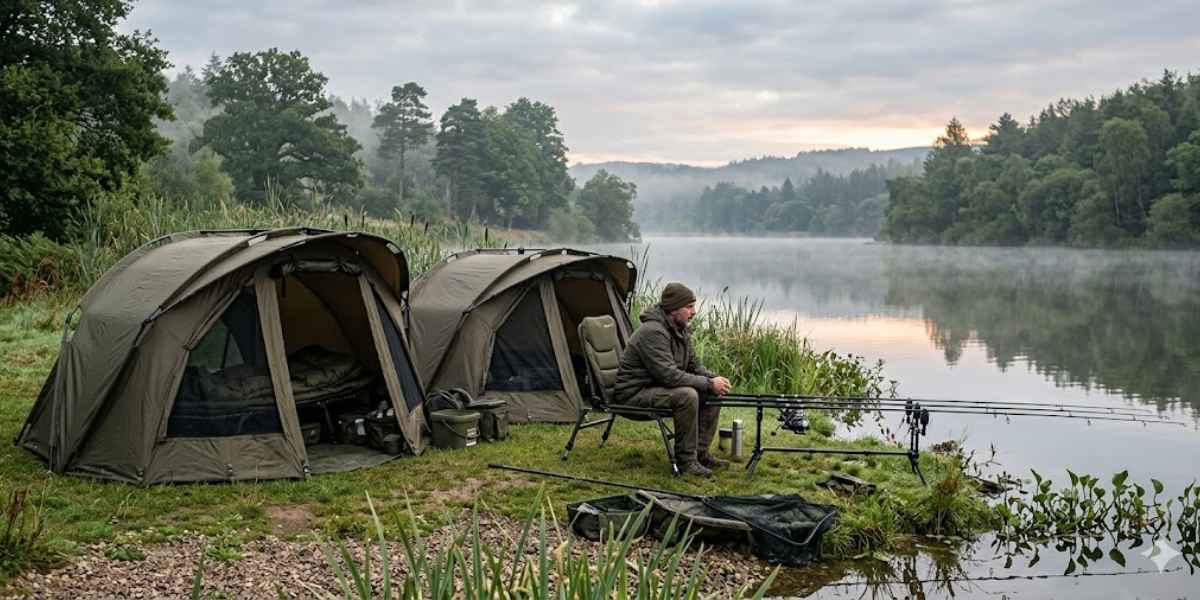
When we test fishing bivvies at eTackle, we don’t just pitch them up on a sunny day and glance at the spec sheet.
We take them to the bank in real conditions wet, windy, exposed swims, and compact pegs to find out how they truly perform session after session.
We score every bivvy using four key categories that reflect real-world usability, durability, and value. Each is assessed independently, then averaged to produce a final score out of 10.
All bivvies are tested during actual sessions, including multi-day trips and challenging weather.
- 1Pegs & storm straps
Pegging options and storm strap set-up that keep it put in a blow.
Stability & weather resistance - 2Frame & hub
Pole type, connection strength and a hub that snaps into place.
Build quality · Ease of setup - 3Groundsheet
Removable or sewn-in, and how it holds up to heavy foot traffic.
Build quality & materials - 4Storm peak & door
Does it genuinely deflect rain, and do the zips and seams hold?
Stability & weather resistance
 Fabric · Frame · Stitching · Floor
Build Quality & Materials
This is where we dig into how well the bivvy is made. We examine the core fabric, frame system, stitching, zips, seams, and attention to detail throughout the design.
We assess:
Outer fabric quality: weight, weave, waterproof rating, and resistance to tears or abrasions
Frame structure: type of poles (aluminium, steel, composite), connection strength, and lock stability
Stitching & reinforcements: especially around pegging points, storm flaps, tension straps and door zips
Floor materials: removable or sewn-in groundsheets and how well they hold up to heavy foot traffic
A bivvy might boast a big hydrostatic head on paper, but if it pools water, leaks at seams, or the poles flex under pressure, it loses marks here.
 Wind · Rain · Storm peak · Venting
Stability & Weather Resistance
A bivvy isn’t worth much if it doesn’t protect you when conditions turn rough.
We test how each shelter holds up in exposed swims and poor weather. Stability in wind, resistance to driven rain, and overall shelter integrity are the focus here.
This includes:
How well it holds shape under high winds
Pegging options and storm strap configuration
Storm peak performance: Does it genuinely deflect rain or just look the part?
Condensation management: through vent positioning, internal space and airflow design
Bivvies that shift under pressure or flood through the base lose serious points. The best ones stay bone dry, even when the weather does its worst.
 Setup time · Weight · Pack size
Ease of Setup & Portability
No one wants to wrestle with poles or waste 20 minutes setting up in the rain.
In this section, we focus on:
Setup time and complexity: can it be pitched quickly and solo?
Pole or hub mechanism: does it snap into place confidently or need excessive tensioning?
Weight and pack size: can you carry it comfortably with the rest of your kit?
Storage straps and bags: are they actually usable after the first session?
Some bivvies look great but feel like a wrestling match every time. Others are built with the angler in mind, and it shows. This is where those differences come to light.
Fair marks for build, top marks for value. It’s a real eTackle score, and it lands at 8.0 overall.
Value for money
This is where we weigh up the full package.
Not just the RRP, but what you actually get in return, performance, features, comfort, adaptability, and durability.
We consider:
Space vs price: how much usable room does it offer for the money?
Inclusions: is a heavy-duty groundsheet, skull cap, or inner dome included, or are they costly extras?
Longevity: how likely is it to survive 4 seasons of use?
How it stacks up against similarly priced models on the market
We’re honest here. A £700 bivvy should deliver top-tier quality. But if a £300 model keeps you drier, sets up faster, and lasts longer, it’ll score better. We reward substance over branding.
How the final score works
Every bivvy is rated out of 10 in each of the above categories. We then average these to produce a final rating, which you’ll find at the top of each individual review.
You’ll always see what earned a product praise or pulled it down, no vague scores, no sugar-coating.
Our process is consistent across all tackle categories, so you can fairly compare a bivvy score with a barrow, shelter, or chair.
For a full breakdown of how we apply our scoring across different tackle types, check out our dedicated review system page.
See the process in action
Have a question about a piece of fishing tackle?
Contact us